

That I’m nervous is a good sign, the worst I’d suffer is some light ridicule. Eyes follow me as I cross the street and the group of men out front seems collectively to wonder what I’m here for. Uh, I’d like to drink a beer?
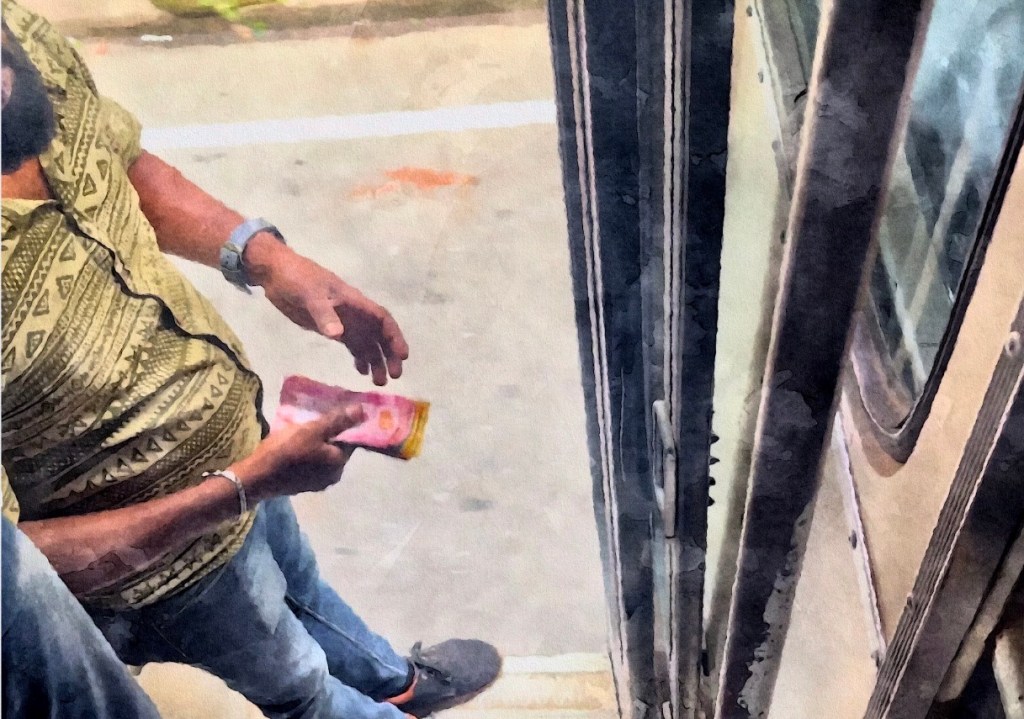
A brawny guy in a red cap and track pants ushers me through the crowded hallway. Customers extend their arms toward the window, folded bills between their fingers, baby birds clamoring to be fed, the mother, a barkeep of sorts, a liquor dealer, you will simply be charged more to consume the merchandise here.
It’s not legal to drink in public. I’ve seen it done, but rarely. Colombo was supposed to have a rich history of “dodgy bars”. History turns out to be the operative word. Yet such places do exist.
In Anuradhapura, I’d offered to take my tuk tuk driver, Bala, to “Beer Bar” for a nightcap. He scolded me, saying it was too expensive. Instead we purchased from the wine shop across the street and drank in the tuk tuk in the parking lot, pissing down the slope at its edge.
When I went alone to “Beer Bar” the next night, I climbed a rickety metal staircase to find an unadorned room with tables and chairs, a TV, and, essentially, a liquor store walled into the corner where a clerk took my order through the bars of his cell.
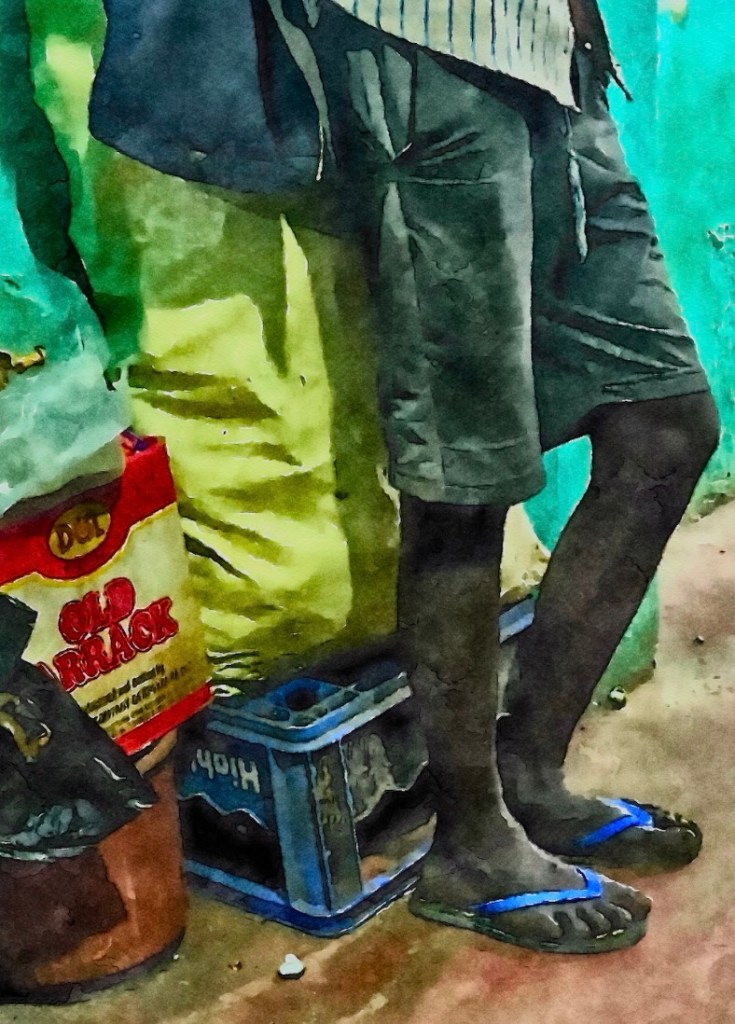
For a strongly prohibitive alcohol culture, Sri Lanka makes a damn fine lager. I opt for the original Lion but these guys aren’t messing around, showing a clear preference for Lion Strong which weighs in at 8.8% abv. If you want to get lit you pair that with a flask of arrack, the local coconut spirit which intrigues until you realize it tastes like rail brandy.
One of the motley crew that’d been loitering in front turns out to be our maitre de. Skinny as a rail, twig legs and bony pelvis wrapped in a sarong, leathered bare feet, oxford shirt with the sleeves rolled up, wrinkly neck, hunched back, gray beard, deeply stained red betel nut teeth. He’s giving orders as well as taking them, making room for newcomers, clearing empties.
I’m seated in the first of two small windowless rooms. Each has a single long table with long benches on either side and a naked light bulb hanging from the ceiling. There’s no music, only the murmur of chatter and clatter of bottles.
Most of these fellows are old and I’ve been put next to the pair closest my age, doubtless a deliberate move on the part of our savvy sommelier. The language barrier near total, I reach for my phone to show pictures of my hometown and places I’ve been. Smoking being another way to share a moment wordlessly, I’m offered a filterless, which will be fine, but my compatriot insists I should get what I prefer and orders me a single filtered cigarette.
My hulking chaperone checks on me periodically, seemingly concerned for my welfare. But I’ve begun to suspect he’s buttering me up, a tuk tuk driver looking for a fare, and sure enough, my comrades confirm it! I don’t need a ride tonight, I reflect, but this area seems worth exploring.
Made the stop only to break up the trip from Kandy to Nuwara-Eliya. Booked a guesthouse near the train station and figured I’d spend the evening roaming around. Come to find out the map had it wrong: the guesthouse wasn’t even in Hatton, much less near the train station, it’d be ninety minutes walking toward the village of Norwood.
When I arrive mid-afternoon, students just released from school flood the streets in white uniform. I join the flow, the only white person in this particular white river, a pedestrian rush hour. Wedged between people, wedged between cars and shops, on sidewalks that don’t exist. A perpetual blaring of horns.
I open my map, looking for a cafe or bar where I might take a pause and weigh options. There is nothing. I quickly conclude this is a blessing in disguise, that my hotel is in the boonies and not this butthole of a town.
Approaching a bus depot a man asks me where I’m going. “Norwood”? He motions at the second bus in line. I confirm with the tout, board, and within two minutes we’re rolling.
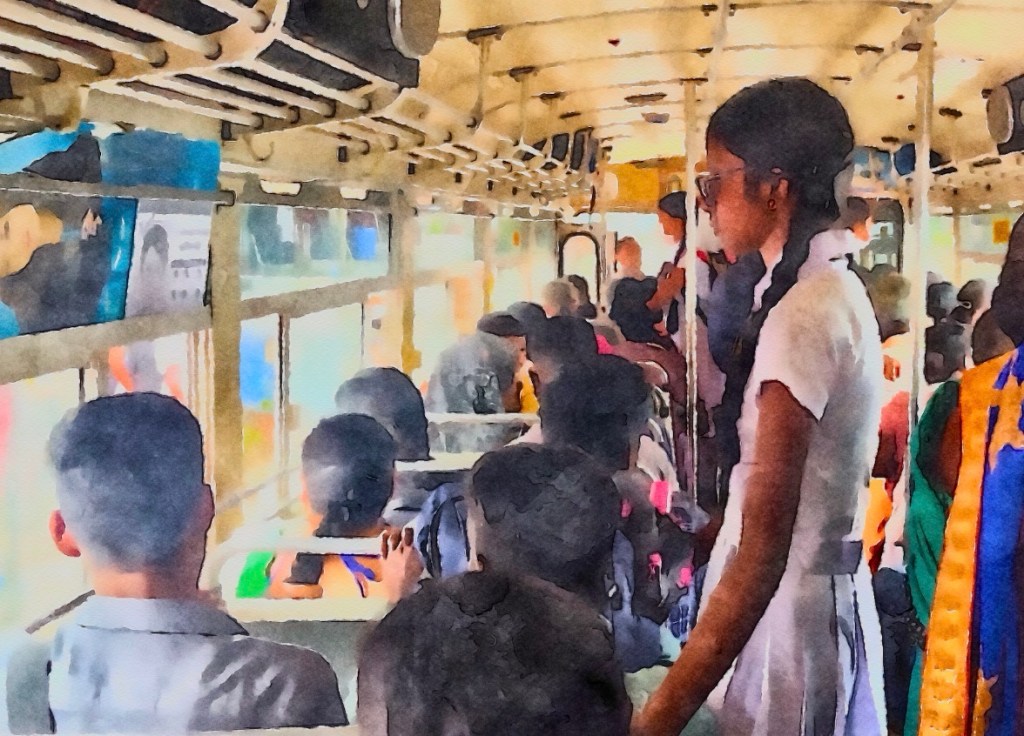
Seats already full and the aisle packed with standing passengers yet we find room for more at every stop, believing that the world is mostly empty space. Heads would bob and sway anyway, but it looks like dancing to the groovy loud music being played. It delights me I can Shazam it in what would seem an impossible situation, though that makes this experience feel that much less adventurous.
I track the blue dot on Google Maps as we wind our way out of the city, over the river, and through the woods to Castlereigh Reservoir. Most passengers are preparing to hop off at the hospital, which makes me nervous this might be the last stop for awhile, so I figure I’ll join them and walk the rest of the way.
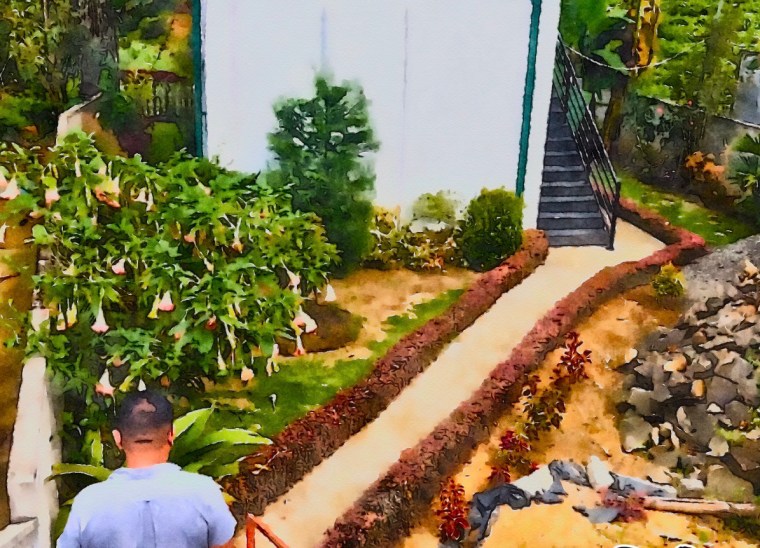
Temperature goldilocks, the air smells of smoke and perfume, pink flowers dangle like bells, trees studded with red-orange blooms. I peer down the hill across a plot of tea. What I’d thought was a bird turns out to be a large bat, beating its wings hard to alight delicately atop a tall tree. Then I notice the branches are full of bats, sleeping, hanging there like black plastic sacks. I wonder if I ought to come back at night.
On a spur off this intoxicating highway is Traveller’s Villa, and its owner, Dhimmika, a beaming smile sauntering toward me. This warmest of welcomes includes a fresh pot of strong black tea which I enjoy from the balcony of my little bungalow in the garden.
It’s dark when I leave the tavern. Sri Lanka is near enough the equator that days and nights are about evenly divided all year round, sun up at 6 and down at 6 by India Standard Time. There’s still a congregation on the stoop.
Seeing my aspiring chauffeur, I broach the subject of a possible tuk tuk adventure for the following day. A drunk interrupts, bellowing at me. My bodyguard shrugs, “Do you understand?”, I shrug, “No”, and he summarily tells the guy to fuck off. I like this cleft-chinned beefcake. We exchange numbers and I tell him I’ll call him in the morning. His name’s Ramesh.
Not a huge fan of Ramesh when he wakes me with a call at 7:40am asking what time I want to leave. Sleep had been hard to come by in the high-elevation cold with only a thin sheet to cover me—my only complaint about an otherwise superlative ten dollar room.
He says it’s best to leave early for Adam’s Peak, the legendary cone mountain popular among tourists at the top of which is a “footprint” of the Buddha for Buddhists, Adam for Christians, Shiva for Hindus, or for others Billions of Years of Geological History. Yesterday evening I’d tried to stress that I wasn’t interested, that I’d rather go to secret places, or glimpse the mountain from the valleys, but I guess we’ll sort it out on the fly. Breakfast isn’t scheduled until 8:30 and I tell Ramesh I’ll call him after.
Dhimmika regrets to inform me that my room is booked for tonight but I can stay at his auntie’s house across the street and leave my bag at his place while I’m out. I call Ramesh and ask him to scoop me at 11. He shows up 20 minutes early, which, it occurs to me, is no more punctual than being 20 minutes late. I have a fresh pot of tea and the New York Times and now I’m making him wait. Determined to have a great day, I put on a smile and stride out to greet my guide with a hearty “Good morning!” and a firm handshake.
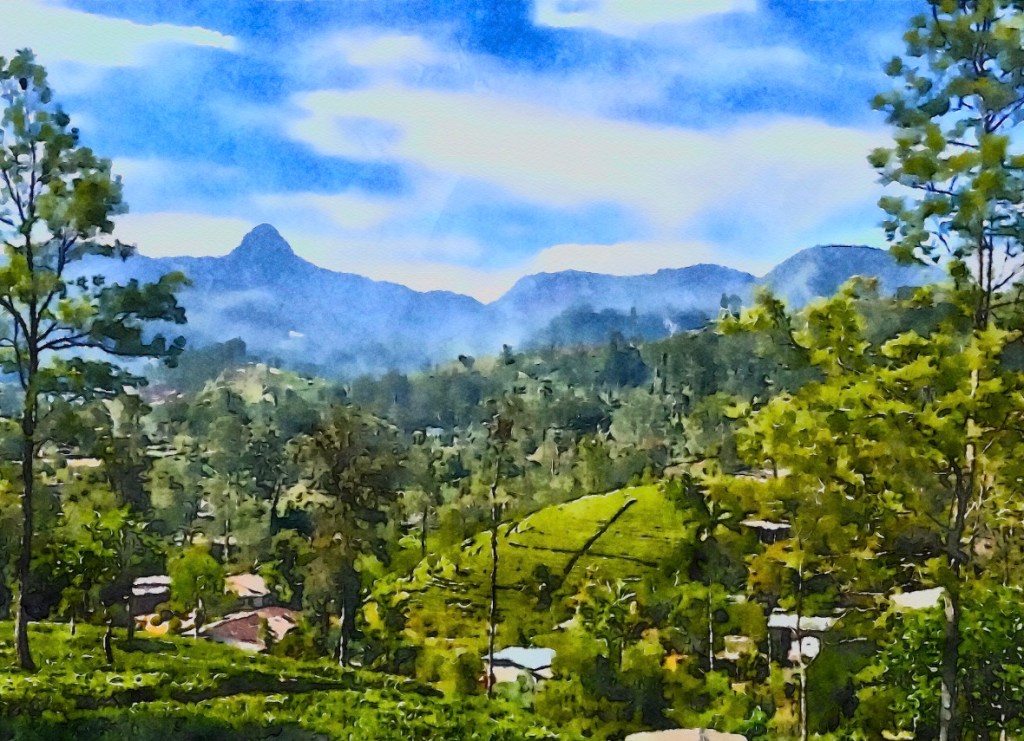
I walked this stretch of road yesterday evening. Passed by two boys who proudly said “Hello!” and I tried to engage a conversation but that was all they could say in English. Passed a young girl who was walking the same direction but she immediately passed me back, only to remain an awkward six feet ahead. Then the boys caught up. I’m trying to relax here! Reminded me of a path in Wisconsin where I happened to be walking just the slightest bit faster than two horses and overheard every word of the riders’ conversation for about twenty minutes on either side of what was possibly the slowest overtake of all time.
People looked at me like an alien. Evening sun cast a warm glow on green peppers, yellow bananas, red tomatoes, and the black skin of the locals, which had a purple hue, and in the light looked velvet. After the market and the Hindu peacock temple the town was over. Then it was like passing from a bay into open ocean, an ocean of tea, the hills like rollers, swelling up to the high mountains in the faraway distance.
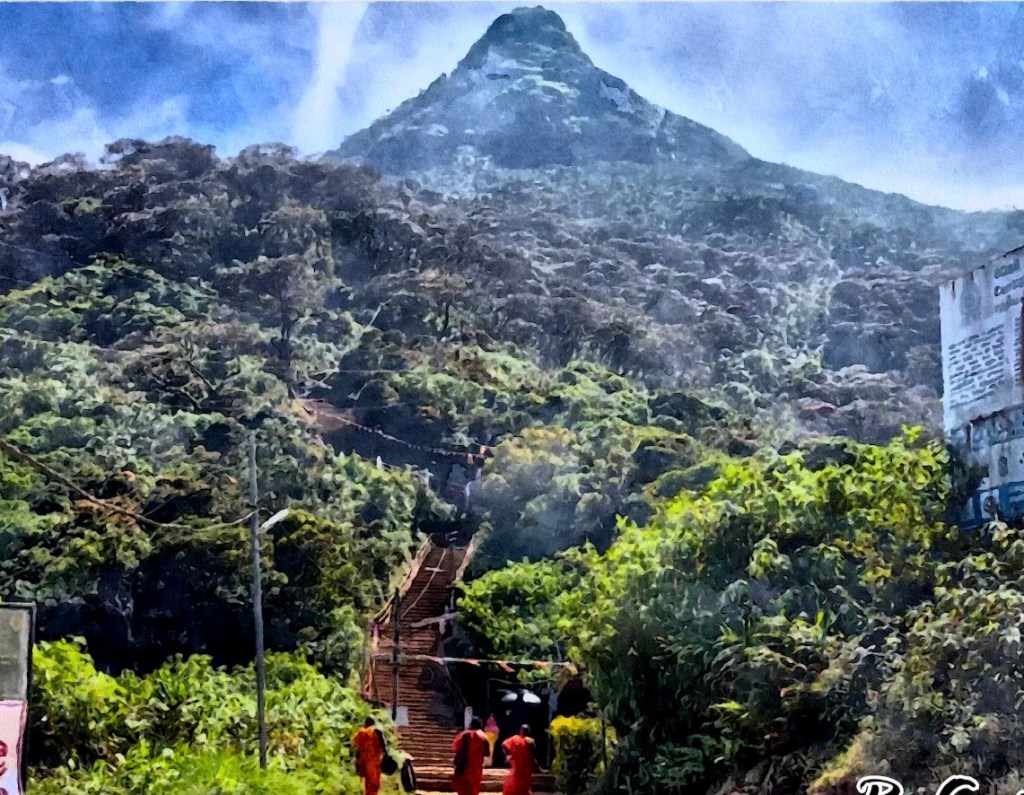
The narrow streets leading to the trailhead have me feeling funneled like cattle into the chute. There’s one entrance and one path and a gantlet of shops hawking souvenirs and cold weather gear to the sentimental and unprepared. It’s popular to ascend during the night in a headlamp conga line to view the sunrise from the crowd which accumulates at the summit. Now at midday it’s hot and hazy. I tell Ramesh I’ll give it an hour, two at most.
Halfway up I pause at a viewpoint to assess the situation. I can see the white stupa down below. I can see the reservoir. I can see the peak and its grandiose staircase. I imagine being up there, squinting at the horizon, snapping a useless photograph. I regard the bald monks slowly ascending like turtles with parasols. I buy an overpriced water and turn back.
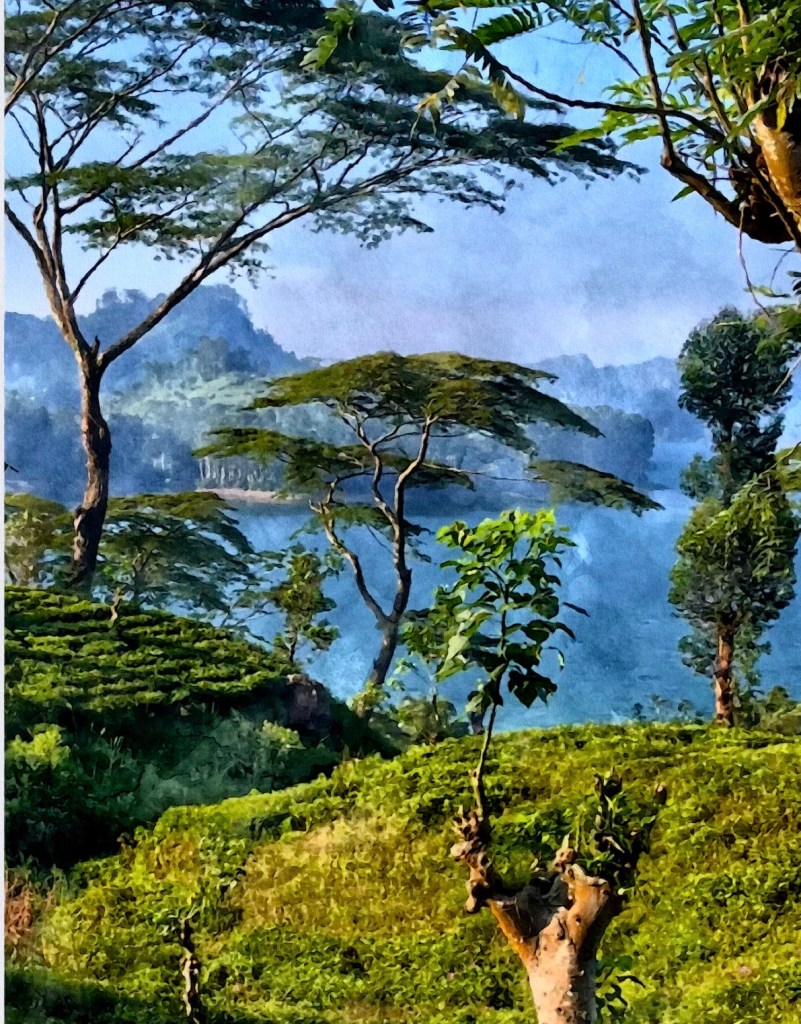
Showing a surprising level of attentiveness, Ramesh scoops me at the gate. Wanting not to hurt his feelings I hem and haw about what I’d just experienced. The lake glints like a film strip between shaggy pines. Seeing fishermen on its shores, I change the subject to what we might eat for lunch. Had plenty of curry and rice on this bountiful isle, but no barbecue, and I’ve got to believe somebody somewhere is cooking something over coals—why not a fish? Ramesh says, “I know”.
The dam was built in 1968, flooding the town of Masikeliya. A half-sunken temple serves as evidence. The new town crawls up the hill and I picture us tacking down to the lakeside where a fresh catch might be cleaned and grilled right in front of us. My heart sinks when we keep to the high road and even low buildings block the sun and we sputter to a halt at the type of shabby local restaurant I love but in this case disappoints before I’ve even looked at the menu.
I tell Ramesh I’ll have what he’s having. What comes is a mountain of fried rice flecked with green onion and carrot and visibly shitty beef. I choke down what I can, wishing I’d got the curry, which looked glossy and delicious, same as all the other ones I’d tried. Ramesh eats half of his portion and asks for the remainder to be put in a parcel. I pay the bill. Ramesh hands his leftovers to a beggar on the street.
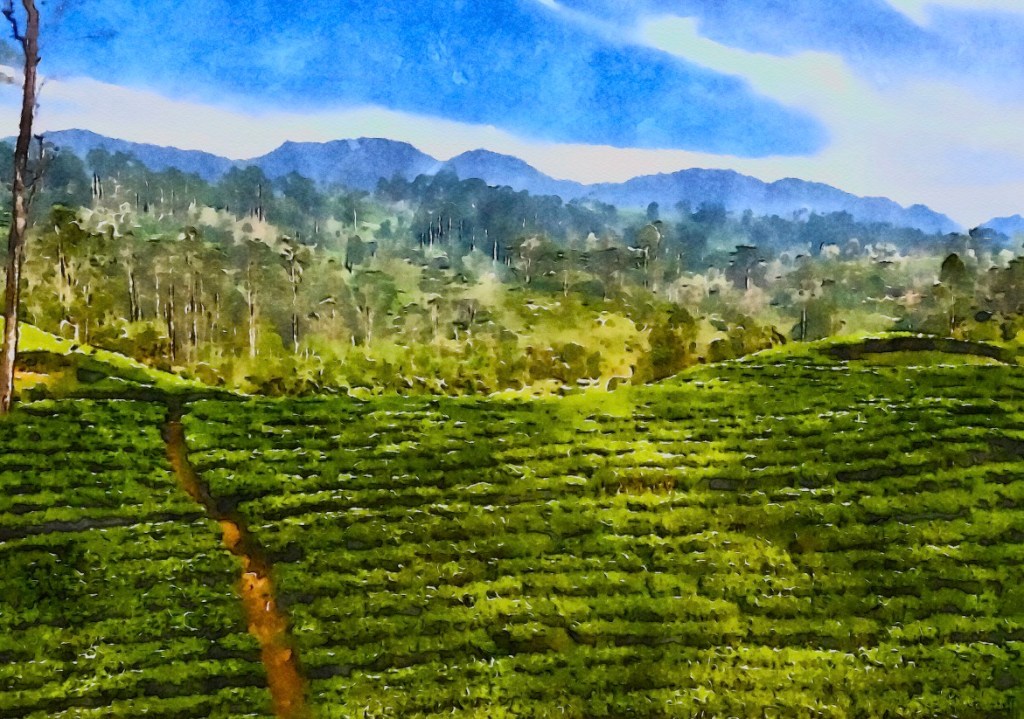
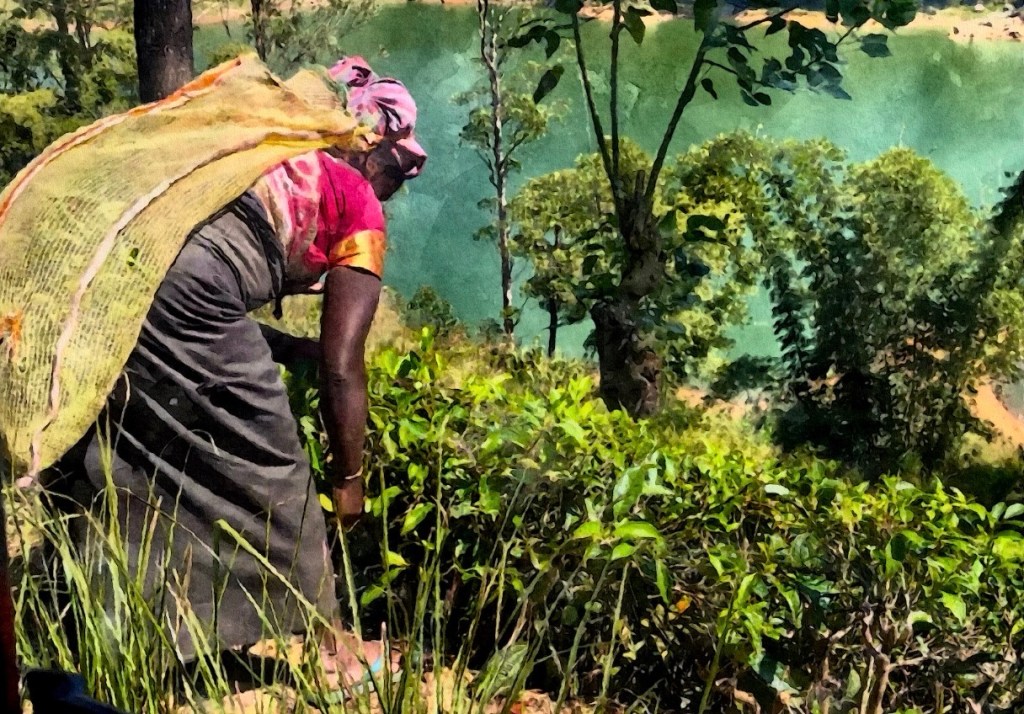
The way he pronounced it sounded like “God-mode” but it’s Gartmore Falls and everybody said it was spectacular. We skirt the reservoir on a serpentine road that describes the contours of its hills as do the countless rows of tea that fold and bend like the wales of my corduroy shorts that had lain rumpled on the bed. Sturdy women pluck the tender young leaves, flicking them over their shoulders into large bags. Muscular trees with smooth gray bark send branches by preposterous routes to the invisible plane at which their leaves comprise a patchy canopy. White light dances on the blue water. The green cone mountain mocks me.
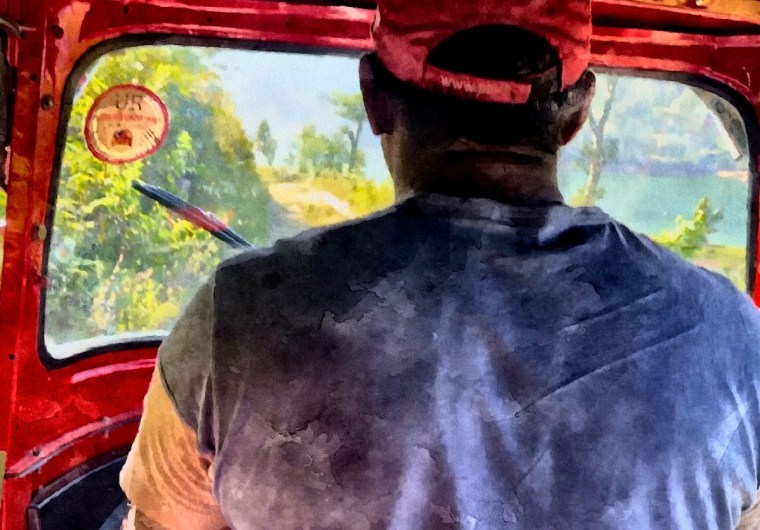
Asphalt gives way to rocks and ruts and we crash along the broken road. Without shock absorption it’s like sitting on a jackhammer. Ramesh stops often to ask for directions. He kills the engine on downslopes to conserve fuel, which I admire. Then the rattle of the frame seems to grow louder, the serenity of our surroundings no nearer.
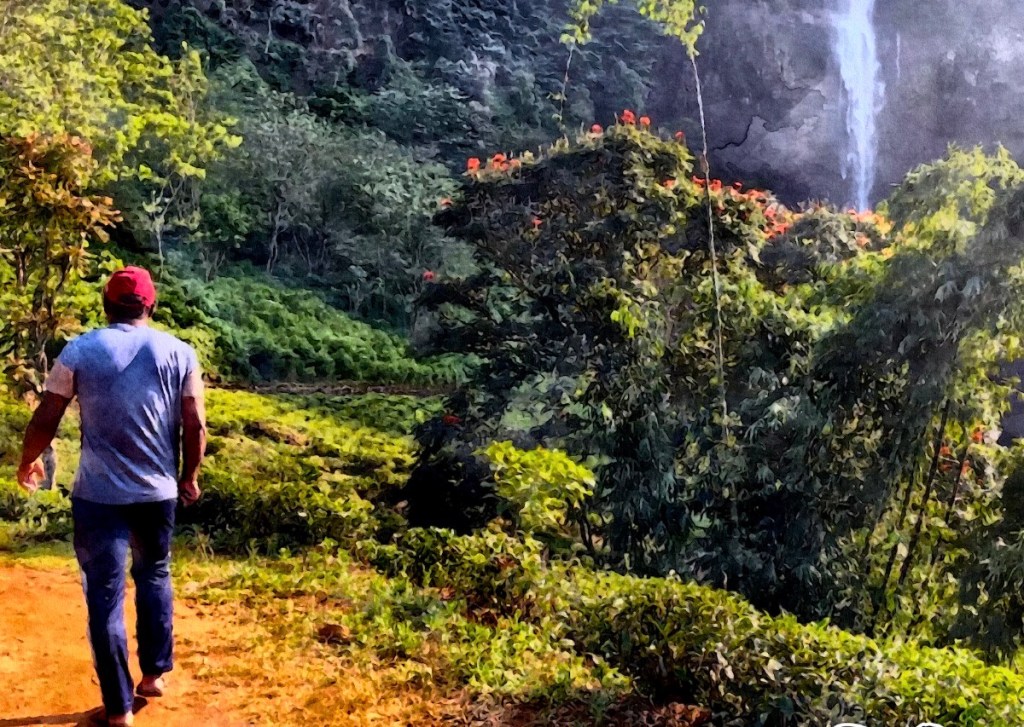
Finally the road dead ends and there it is, a 200 meter cascade tumbling down a steep embankment into the lake. “Beautiful”, Ramesh offers, motioning toward it. I’d go for a swim but now the heat of the day has passed and the cove is in the shadows. Another mistimed visit. Nothing to do but kick rocks. Ramesh stares vacantly at the waterfall. I regard his thick, hairy neck. The place is beautiful, as he said, but neither of us seems particularly happy to be here, as though coming was an obligatory chore and praising a mere act of obeisance.
Three young men arrive on motorcycles and I reflect, matter of factly, that that would have been the God-mode of transport.
It seemed perverse to travel Central America and not find a good cup of coffee on the road and the same is true here among the lush plantations. The world’s second largest exporter of tea ships out most of the good stuff and what’s left is available only at the factories. This late in the day it’s doubtful any are open and anyway Ramesh doesn’t strike me as a connoisseur. I propose we have a cup of tea at a place of his choosing.
He takes me to a ramshackle joint which will do just fine, and I don’t care if it’s dust in a paper cup if it’s cheap and strong. It’s apropos that even here I’m thwarted, having strenuously declined the offer of sugar but being served the same sweetened brew Ramesh had asked for, and so weak as to be an affront to the millions of tea leaves within earshot.
He quoted me 4,000 rupees to Adam’s Peak so I’m thinking add another 4,000 for Gartmore Falls and then tack on 2,000 for a tip, and I’ll hand him a crisp 10,000 rupee note. When we arrive back at Traveller’s Villa I make my offer but he wants 1,000 for a “waiting fee” at the peak and 6,000 for Gartmore Falls. I decide not to haggle, considering that the drive had been long and arduous, and happily fork over 13,000 rupees, or about $35. We shake hands and our business is concluded.
I sit on Dhimmika’s porch and crack a Lion Lager. A young couple park their scooter and head down to the room I’d occupied last night. I think, “Damn, they got my room”, and then, “Damn, they got a scooter”.
At dinner, I get a Facebook message from Ramesh, a screenshot of a translation from Sinhalese to English saying, “Thank you for helping me in my predicament”. Oof. Days later I would sever our connection after receiving phone calls at odd hours and messages begging for work in the United States.
The couple with the scooter tell me they’d been to Adam’s Peak that morning. They show me a picture of the sun peeking over the horizon and below, a sea of clouds. I’m unmoved, and you can say this is just me rationalizing my decision, but every time I fly in an airplane I rise above the clouds.

 Uncharted Dives
Bravo, look forward to the next tale from Long Tong!
LikeLiked by 1 person